

Video 1
04/12/2025
The Rudong solar–hydrogen offshore energy farm, covering roughly 287 hectares, is expected to produce 1,500 m³ of hydrogen per hour and 468 million kWh of electricity per year, significantly reducing emissions.
The Rudong offshore solar–hydrogen storage farm, located in the tidal-flat area of Jiangsu Province in eastern China, has officially begun operations, according to Global Times.
This is China’s largest facility of its kind, managed by Guohua Energy Investment under CHN Energy Group. It is also China’s first coastal ecological management and integrated energy-development project capable of solar-power generation, hydrogen production, hydrogen refueling, and energy storage.
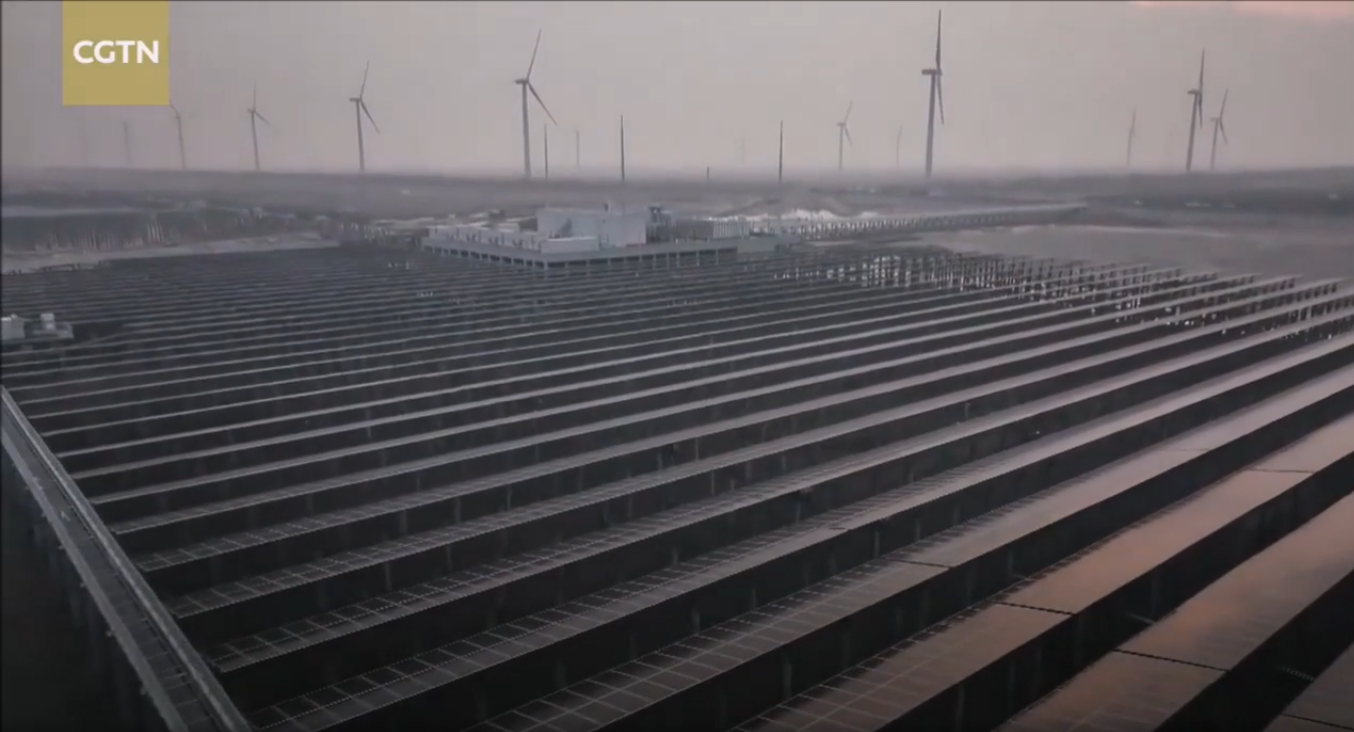 Rudong offshore solar–hydrogen storage farm
With a total installed capacity of 400 MW, the Rudong project spans about 287 hectares, and includes:
A newly built 220 kV onshore booster station,
A 60 MW / 120 MWh energy-storage system,
A hydrogen production and refueling station capable of producing 1,500 standard m³ of hydrogen per hour through water electrolysis, and dispensing 500 kg of hydrogen per day.
Once fully operational this year, the farm is expected to generate an average of 468 million kWh of electricity annually, equivalent to saving approximately 151,000 tonnes of standard coal. This will significantly reduce emissions, including an estimated 309,400 tonnes of CO₂, 562.6 tonnes of SO₂, and 1,125.3 tonnes of NO₂. Such reductions not only make a major contribution to environmental protection but also mark an important milestone in transitioning toward a more sustainable energy structure.
The Rudong project leverages the region’s unique coastal tidal-flat resources, using advanced photovoltaic technology and intelligent control systems to optimize energy conversion and storage efficiency. By integrating hydrogen production, the project enhances overall energy utilization efficiency. According to CHN Energy, this innovative approach not only strengthens the grid’s adjustment capacity but also greatly improves the stability of local power supply.