


Video 1
04/12/2025
Incidents of falling trees causing injuries and even fatalities on the streets of Ho Chi Minh City during the rainy and stormy season are becoming increasingly serious, raising red-flag concerns about urban tree safety.
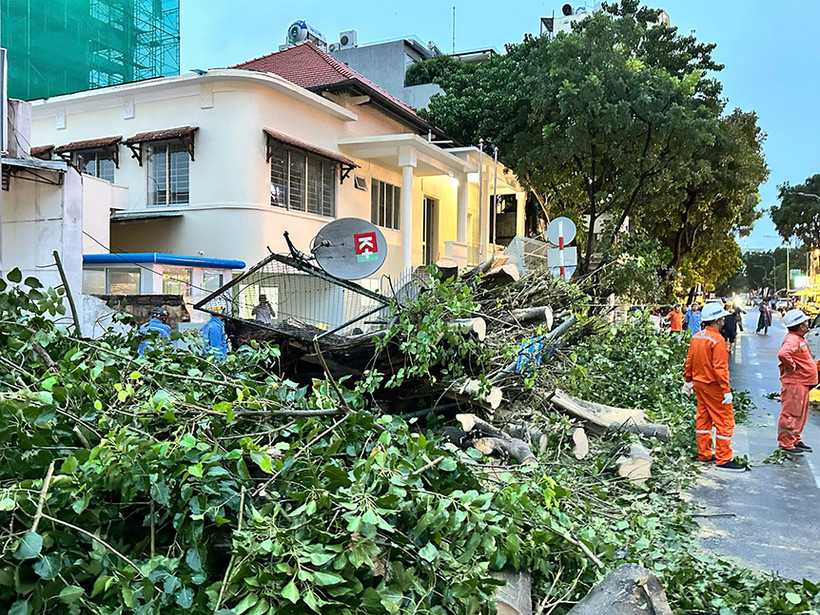 City Greenery Park Company workers clear fallen trees.
Rapid urbanization
Ho Chi Minh City currently has more than 300,000 roadside trees, of which the Department of Construction manages nearly 118,000. According to the city’s Technical Infrastructure Management Center, the main causes of tree-related incidents stem from rapid urbanization: high-rise buildings and widespread concrete structures have altered wind direction and increased wind intensity.
In addition, the expansion of underground infrastructure has significantly affected tree root systems. Abnormal weather patterns and environmental changes further impact tree growth, development, and resilience.
Another factor is human behavior—intentional damage, lack of awareness, and careless construction activities surrounding tree areas.
The city has nearly 11,000 heritage trees, many planted decades ago alongside the development of the city. These include iconic species such as sao đen and dầu rái. Balancing the preservation of these “green heritage assets” with ensuring public safety is a major challenge. In the long term, authorities need to plan for phased replacement and rehabilitation of aging trees while still maintaining cultural and ecological value.
A difficult challenge
According to Ho Chi Minh City Greenery Park Company, which is responsible for maintaining nearly 86,000 trees, inspections mainly rely on visual assessment and professional experience due to the lack of specialized equipment. As a result, hidden defects—such as root damage underground or high branches 20–30 meters above ground—are difficult to detect.
Associate Professor Dr. Đặng Văn Hà, Director of the Institute of Landscape Architecture and Urban Greenery, notes that many trees in central districts have grown into large, old canopies after more than 30 years but have not been pruned properly. Most pruning is done on lower branches, while top canopies are left to grow too high and unbalanced, making them more prone to breaking—such as the recent incident at Tao Đàn Park, where an overly long, sagging branch caused an accident.
He also pointed out poor planting practices at some locations—concrete poured around trunks, improperly built tree pits, or tightly paved stone surfaces—restricting root respiration, damaging main roots, and leaving only fine roots to hold the tree, greatly reducing stability.
For prevention, schools, parks, and agencies should select resilient shade-giving species with flexible branches such as small-leaf almond, sao đen, sấu, giáng hương or gõ đỏ, depending on the area. Trees should be inspected regularly to monitor seasonal leaf shedding and flowering patterns. Symptoms like excessive leaf drop, drooping branches, or early discoloration often signal internal decay.
He added that trees in busy city streets should not exceed 20 meters in height. Heritage trees over 30 meters must be pruned or structurally supported in phases to prevent wind damage that could progressively weaken or kill them.
Applying science and technology
According to Director Lê Công Phương of the Greenery Park Company, the unit has begun investing in tree-diagnosis equipment such as mechanical resistance testers. These devices use a drill-driven needle to measure density inside the trunk to detect hidden wood defects. However, data interpretation still requires expert knowledge.
Therefore, the company is working with scientific institutions to test the equipment on local tree species, build a reliable database, and gradually develop a scientific assessment procedure—aiming to improve long-term urban tree management.