

Video 1
04/12/2025
Experts hope that the development of “green” lending in Vietnam’s two emerging international financial centers — Ho Chi Minh City and Da Nang — will soon be implemented. Such mechanisms would provide businesses and individuals with financial resources to invest in green projects such as renewable energy and sustainable agriculture, helping Vietnam accelerate its goal of greening the economy.
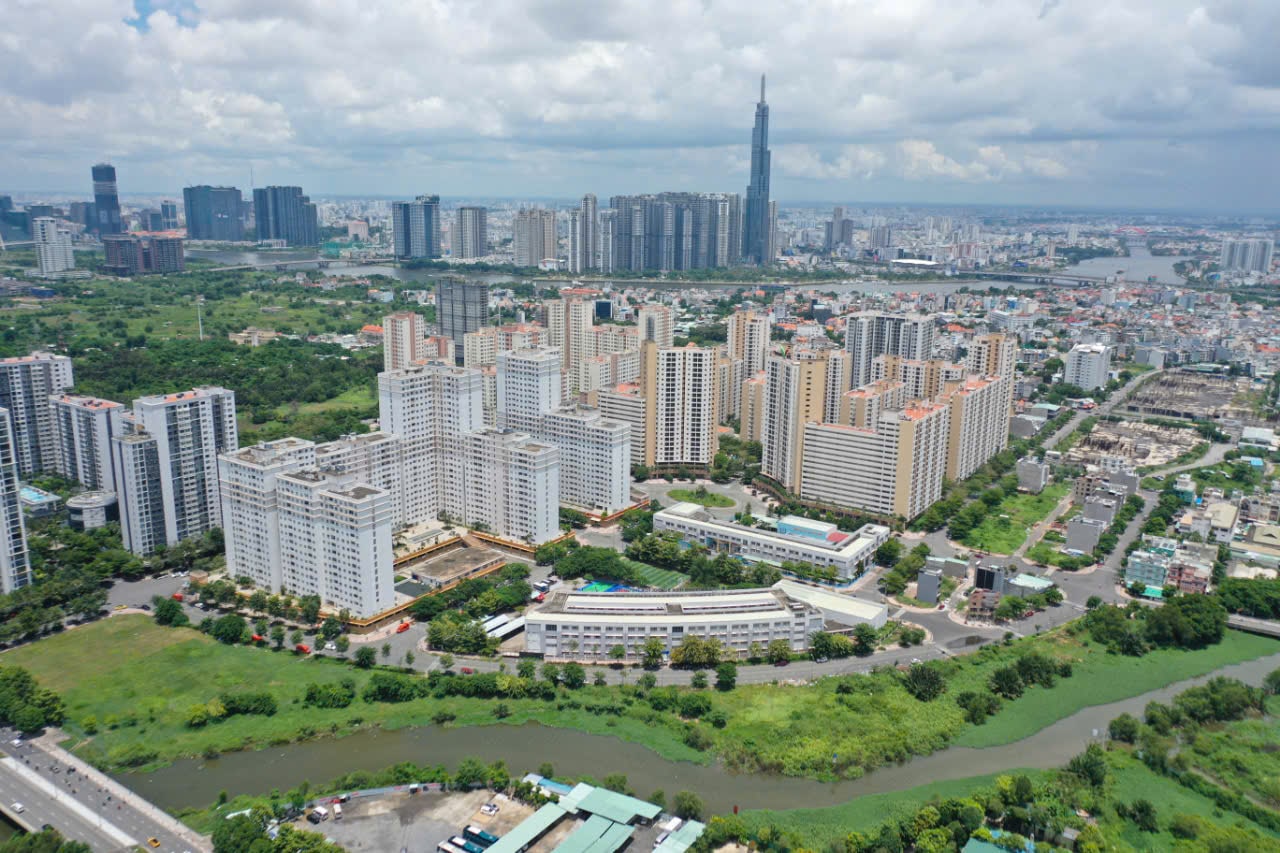 Illustrative image: International financial centers in HCMC and Da Nang are expected to become incubators for green capital.
Domestic Enterprises Struggle with Green Finance
The textile and garment industry emits an estimated 100 million tons of solid waste from discarded clothing each year. For each standard textile product, around 20 cubic meters of water is used from cotton cultivation to finished goods. With 100 billion textile products produced annually, global water consumption reaches 2,000 billion cubic meters.
Because of this, the sector is among the most regulated industries globally in terms of circular economy and green-economy requirements.
In the context where green transformation is no longer a trend but an essential requirement, Mr. Lê Tiến Trường, Chairman of the Board at Viet Nam National Textile and Garment Group (Vinatex), acknowledges that Vietnam’s textile industry must adapt to green and sustainable development trends.
However, Mr. Trường notes that implementing ESG and circular-economy practices remains a major challenge. Regulations on greenhouse gas monitoring and carbon taxation lag behind international timelines. Additionally, Vietnam’s financial system for circular economy, green economy, and ESG financing is still nascent, making it difficult for green textile projects to mobilize capital.
“At this stage, it is crucial to develop a comprehensive green-finance framework to support businesses in research, innovation, and investment in raw-material production,” he emphasized at the Vietnam Economic Scenario Forum (VESF 2025).
Meanwhile, Ms. Diệp Thị Kim Hoàn, Sustainability Director of Deep C Industrial Zones Complex, stated that the lack of information on green-credit institutions makes it difficult for SMEs to access green financing. Furthermore, the actual financial costs — including interest rates, guarantees, and processing fees — remain high. For foreign-loan projects, exchange-rate risks add additional burdens.
She also pointed out the absence of unified green-project criteria, leading to varying requirements among credit providers.
“Many green-credit funds do not accept collateral. Businesses must obtain bank guarantees instead. Moreover, most green projects are small-scale — under USD 30 million — making it difficult to qualify for international loans,” Ms. Hoàn added.
According to a survey by the Private Sector Development Committee (Committee IV) covering 2,734 enterprises, 50% said they struggle with financing for green transition. By sector, industry and agriculture–forestry–fisheries face the highest obstacles, at 53.7% and 52.9%, respectively. Domestic firms also struggle more with access to capital than FDI enterprises (50.3% versus 46.6%).
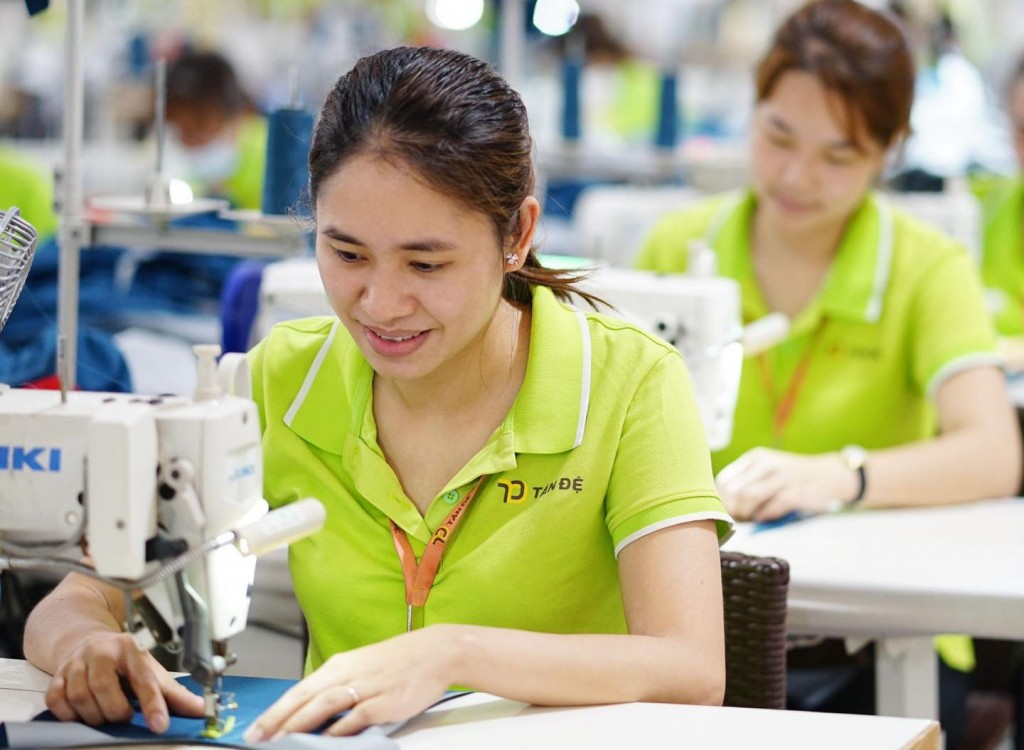 Tân Đệ Garment Company is one of the enterprises actively promoting green production to enhance competitiveness. (Photo: DNCC)
What Can International Financial Centers Deliver?
As Vietnam accelerates green and digital transformation across all sectors, many experts believe the forthcoming international financial centers in HCMC and Da Nang can become “incubators” for green capital.
The Tony Blair Institute for Global Change (TBI), in a proposal to the Ministry of Planning and Investment, recommends positioning green finance as one of the core pillars. The rationale: the global green-finance market — covering green bonds, loans, and equity financing for green IPOs — grew 100-fold between 2012 and 2022, and is expected to surge further.
To leverage this momentum, Vietnam’s international financial centers could establish platforms for issuing and trading green financial instruments, thus improving market liquidity and depth. For example, developing the green-bond market through tax incentives and credit guarantees for issuers and investors.
Another approach is developing green loan products, offering capital to businesses and individuals investing in renewable energy, energy efficiency, and sustainable agriculture.
“International financial centers can encourage banks to offer green loans through liquidity support and risk-sharing mechanisms, while creating pathways for green venture capital and private equity funds to invest in green companies. In addition, developing green insurance products would help mitigate risks associated with green projects,” TBI suggested.
From the lender’s perspective, Mr. Lê Hoàng Tùng, Deputy CEO of Vietcombank, admitted that Vietnam still lacks a fully established legal framework for carbon-credit markets and ESG standards. Moreover, ESG and carbon-credit data evaluation requires unified and robust data infrastructure.
Therefore, regulators must promptly finalize definitions, standards, sector classifications, and the legal framework for Vietnam’s carbon-credit trading market. Additionally, stronger tax incentives and capital-support mechanisms should be considered to accelerate enterprise participation in green finance.
Furthermore, Vietnam must build a national ESG and carbon-credit database, potentially incorporating blockchain technology to ensure transparency and accessibility for businesses, investors, and regulators. Training programs to increase ESG and green-finance awareness are also urgently needed.
Developing Vietnam’s Green-Finance Talent Pool
Da Nang has strong potential to become ASEAN’s first green-finance hub. According to Associate Professor Phan Quang Tuấn from the University of Hong Kong, regulators and local authorities must invest heavily in building a workforce specialized in green finance and ESG — expertise required for green bonds, carbon credits, and sustainable investment instruments.
Vietnam could send officials to participate in Singapore Green Finance Centre (SGFC) programs — a partnership between Singapore Management University and the Asia Institute of Finance — to meet ASEAN’s growing need for green-finance professionals. Similarly, research, workshops, and training initiatives from the European Investment Bank (EIB) and the Green Finance Institute (GFI) could help standardize knowledge and skills in green finance.
“These efforts will not only direct capital flows into sustainable sectors but also create solid foundations for the future global green-finance workforce. They will help attract talent and investment to Da Nang, promote sustainable economic development, and build a better living environment for the community,” Mr. Tuấn emphasized.