


Video 1
04/12/2025
Mango peels and green nettle plants have added new diversity to Vietnam’s sustainable fashion products, alongside earlier materials made from agricultural by-products such as coffee grounds, seashells, and the stems, leaves, and seeds of lotus plants.

Fashion made from agricultural by-products is becoming an increasingly diverse topic in Vietnam. It can stem from a university project, a startup, or a business entering new niches within the global sustainable fashion landscape. However, everything is still in the early stages, even though some projects began as far back as eight years ago.
From the “mango leather” project of Tra Vinh University students
In 2022, mango prices in the Mekong Delta collapsed. During a visit to a mango farm in Tra Vinh, Nguyễn Thị Thanh Vân and her friends were heartbroken to see farmers wanting to uproot their mango trees and replace them with more profitable crops.
Vân, a finance major at Tra Vinh University, noticed that manufacturers usually use only the fruit’s flesh while discarding the seed and peel. After researching international studies, she came up with the idea of transforming mango peels into plant-based leather—an emerging trend in sustainable development.
At first, Vân and four classmates simply sun-dried the mango peels, but they ended up moldy and deformed. The group then moved their research into the lab. After many trials, they developed a processing method.
Discarded mangoes from production lines were collected, the flesh removed, and the peels cleaned. The peels were then boiled, pressed, dried, mixed with additives, poured into molds, and shaped into mango leather sheets the size of A4 or A5 paper.
The resulting mango leather comes in naturally occurring colors—from white (young green mangoes), to reddish brown (ripening mangoes), to deeper brown (overripe mangoes). The team also shortened production time to 16 hours from the original two days. They continue experimenting with blending peels from other fruits to diversify the leather’s colors.
The “mango leather” meets environmental criteria with “three no’s”: no solid waste, no wastewater, and no emissions.
The material is used to make wallets, cardholders, keychains, glasses cases, and more. At the Texture Vietnam textile exhibition in September 2023, Vân shared that several companies in Vietnam and Japan had already inquired about placing orders for accessories.
By the end of the year, S2M—the mango leather project by five Tra Vinh University students—won third prize at the 2023 National Creative Tech Startup Ideas competition (RnD to Startup) held in Hanoi. The judging panel included “sharks,” tech corporations, banks, and investment funds.
The broader story of sustainable fashion in Vietnam
Globally, plant-based and vegan leathers are produced from various materials. In Japan, such leather is made from peanut-skin fibers; in the U.S., from mushroom mycelium; and even from lab-grown cow cells.
The vegan leather market has boomed in recent years, reaching USD 39.5 billion in 2022 and projected to hit USD 74.5 billion by 2030, according to U.S.-based Sentient Media. Researchers attribute this surge to global demand for alternatives to animal leather as well as ethical and environmental concerns. As a result, countless vegan leather makers and fashion brands have introduced products made from diverse materials.
Global luxury houses have also adopted products from small startups. In March 2023, Hermès and MycoWorks unveiled a revamped Victoria bag made with Sylvania—an exclusive amber-colored mushroom-based leather. British menswear brand Vollebak introduced biodegradable T-shirts made from eucalyptus, oak, and algae powder.
In Vietnam, sustainable fashion using natural or agricultural waste materials began gaining attention around early 2020 as the Covid-19 pandemic unfolded. It started with Veritas’ coffee-ground fabric masks and expanded to coffee-ground cups made by Vietnamese companies. Others followed, such as Ecosoi pineapple-fiber silk made from the leaves and stems in Quỳnh Lưu, Nghệ An.
Faslink is one of Vietnam’s pioneers in researching and applying new textile technologies and materials. The company has developed fabrics made from coffee grounds, pineapple fibers, lotus stems, corn husks, oyster shells, and more. Defatted coffee grounds are pulverized and blended with plastic pellets from recycled bottles to create breathable, stretchy fabric. Lotus fabric—made from lotus leaves, stems, and seeds—is soft, silky, and cool when turned into underwear, shirts, or scarves. Oyster-shell fabric—processed from shells discarded along beaches and in restaurants—produces smooth textile that can reduce body temperature by up to 2°C when worn. According to CEO Trần Hoàng Phú Xuân, coffee fabric and nano-fabric account for around 60% of Faslink’s revenue.
Currently, these innovative materials raise production costs. CEO Phạm Chí Nhu, founder of online fashion brand Coolmate, said garments made from coffee fabric cost 10–15% more than regular items. Hồ Trần Dạ Thảo of Tsafari noted that in higher-end segments, the price difference can reach 30%.
Reducing this price gap to encourage consumer adoption remains a major challenge. At the TexTalk fashion seminar in Ho Chi Minh City on July 4, Sandra Vũ, founder of Vietnam UX School, said: “Brands can reduce marketing costs to lower the price of sustainable fashion items—because the lifestyle values themselves already act as the product’s promotion.”
Stinging nettle — the next emerging star
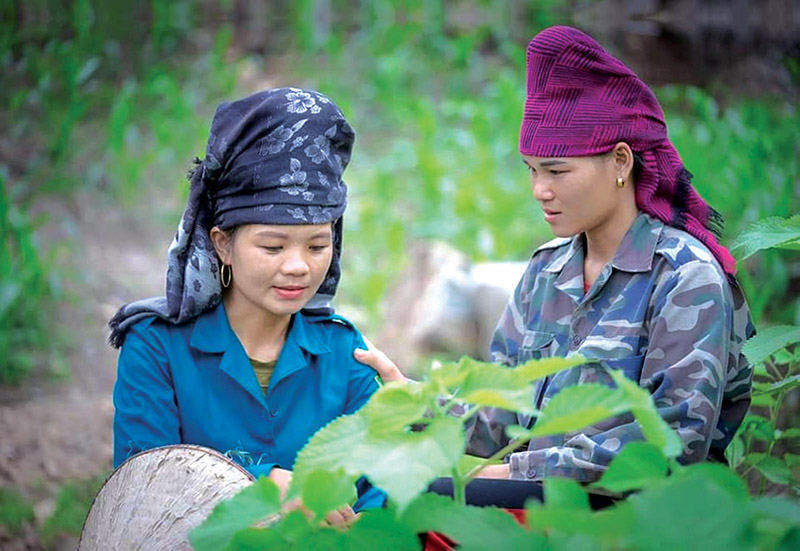
The nettle plant—also known as green ramie—is far from unfamiliar to Vietnamese people. Its leaves are traditionally used to create the deep-black color of the bánh ít lá gai cake or serve as animal feed. The bark is spun into fiber by ethnic communities in mountainous regions. The inner core can be used as raw material for paper production, as a substrate for mushroom cultivation, or as organic fertilizer. Fresh ramie roots are also used as medicinal ingredients.
At a seminar organized by An Phước – Viramie, agricultural expert Prof. Dr. Nguyễn Lân Hùng highlighted many advantages of ramie fiber: it is longer than most other natural fibers and 7–8 times stronger than cotton or silk. Fabrics woven from ramie fibers are easy to dye, naturally antibacterial, stain-resistant, and able to withstand hot water during washing. For these reasons, many luxury fashion brands around the world are embracing ramie-based textiles.
Various Vietnamese startups and companies are exploring the potential of the ramie plant at different scales. One startup with an unusual name—Kilomet109 in Hanoi—has gained international attention by producing ramie fabrics dyed with indigo using traditional techniques of the Nùng ethnic community in northern Vietnam.
However, the local ramie variety typically grows only 1–2 meters tall. To address this, An Phước – Viramie partnered with scientists at the Institute of Agricultural Genetics to import and select superior global varieties. In 2016, researchers created the AP1 green ramie variety, which grows up to 3 meters tall and yields 2–2.5 times more fiber than native ramie.
An Phước – Viramie invested 628 billion VND to build a fiber processing plant in Cẩm Thủy District, Thanh Hóa Province. While the total AP1 cultivation area nationwide currently reaches only about 1,400 hectares, the company needs around 6,300 hectares of raw material zones. Thanh Hóa has approved a development plan for 3,000 hectares of green ramie, converted from low-efficiency farmland; the total area could expand to 6,500 hectares.
The company is also encouraging farmers in Vân Hồ, Mộc Châu, and Mai Sơn districts of Sơn La Province to grow AP1 ramie, with guaranteed purchasing commitments, according to the company’s website (https://viramie.vn). Lào Cai and Quảng Ngãi are currently piloting AP1 cultivation as well.
Vietnam’s textile and fashion industry still imports 50–90% of its raw materials from China—a major vulnerability during disruptions such as the Covid-19 pandemic or amid current geopolitical tensions. Global scrutiny of cotton and fibers originating from China’s Xinjiang region has further increased the demand for alternatives. As a result, linen from India and fibers from jute or green ramie in Vietnam are drawing greater attention.
However, for An Phước – Viramie’s initiatives to pave the way for Vietnam’s textile industry, or for Nguyễn Thị Thanh Vân’s small-scale S2M mango leather project to expand and gain influence in the sustainable-fashion sector, there remains a long road ahead.
This journey requires sustained support for sustainable development strategies benefiting both farmers in raw material regions and the fashion–textile sector, where An Phước – Viramie is emerging as a leading force.
For S2M, the challenge lies in continued investment in technology development and product commercialization. Before this, the Dutch startup FruitLeather had already developed large mango-leather sheets spanning tens of square meters. Their mango leather is currently being used by fashion brands to make high-value leather shoes and jackets.
Hồ Nguyên Thảo