


Video 1
04/12/2025
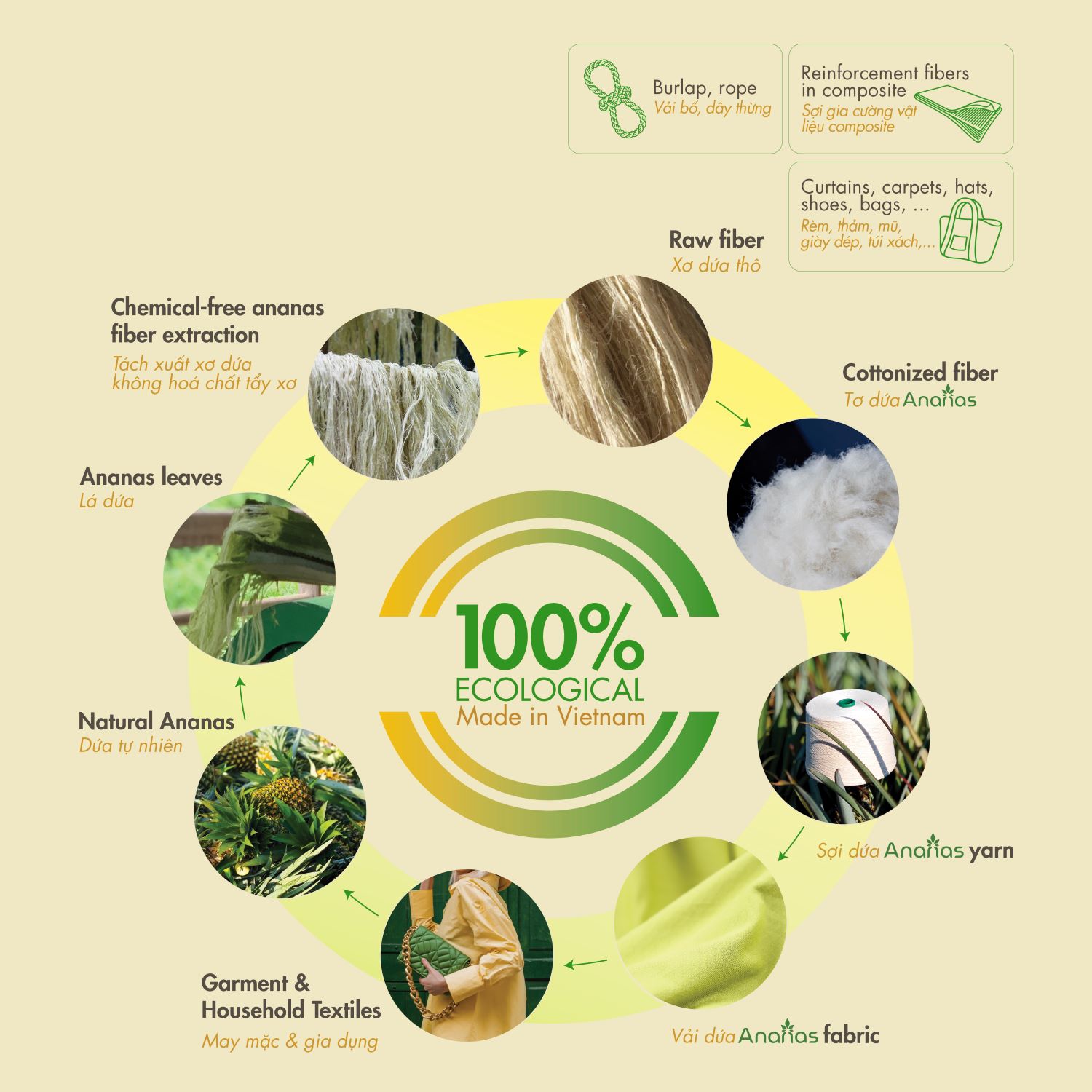
The successful production of Ananas eco-woven silk, yarn, and fabric from pineapple leaf fiber has marked the first time Vietnam has successfully produced on a large scale an eco-textile material from plant fiber. Accordingly, the eco-woven silk, yarn, and fabric made in Vietnam can be mass-produced to fiber-fabric manufacturers, apparel-fashion-accessories-furniture brands, etc.
Thus, the made-in-Vietnam eco yarn market ensures a transparent supply chain of textile materials originating in Vietnam, from harvesting pandan leaves, extracting raw fibers, to producing silk, supplying yarn, distributing finished textiles…
With the green living trend promoting a wave of Southeast Asian startups “reviving” pineapple fabric for widespread application in contemporary life; at the same time joining the race to become a pioneer manufacturer to mass-produce pineapple fabric, Vietnam has launched Ananas.
This is the result of strategic cooperation between Ecofa Vietnam – a cottonized fiber producer and Bao Lan Textile – a developer and provider of R&D solutions for fabric fibers on demand for textile and garment enterprises and fashion brands.

The key to the success of the idea of “mass production of pineapple fiber for mass consumption” is the ability to “spill” raw pineapple fiber by machine on a large scale. In fact, many startups in the region have failed at this step. However, this is the strength of Ecofa Vietnam.
Cooperating with farmers and cooperatives in Dien Bien, Ninh Binh, Thanh Hoa, Nghe An, and Tien Giang to harvest pandan leaves, Ecofa Vietnam started producing pineapple cotton fiber using a machine invented by its founder, young engineer Dau Van Nam, in mid-2021. By early 2024, Ecofa was able to supply 18 tons of pineapple cottonized fiber from more than 1 million tons of pandan leaves harvested each month. Production is expected to increase to 50 tons/month by the end of 2025.
“In the context that the domestic and international textile and garment industry is still lacking raw materials for green fashion production, the success of Bao Lan Textile and Ecofa Vietnam in researching and mass-producing pineapple fiber of sufficient quality for garment fabrics has had a very positive impact on the demand and development of the textile and garment industry, not only within Vietnam’s borders” – Ms. Nguyen Thi Tuyet Mai, Deputy General Secretary of the Vietnam Textile and Apparel Association (VITAS) said. This product also marks a major turning point for the connection between Vietnam’s pineapple agriculture industry and the global green fashion trend.
In addition to transparency in the origin of raw materials, this achievement also brings about vertically integrated raw material supply chain assembly activities. Ready-to-spin pineapple silk and blended yarn provided by Ecofa to Bao Lan will create Ananas pineapple yarn and fabric products for the textile, garment, fashion, and interior industries… The product was inspected by the Ho Chi Minh City Textile Research Institute (VTRSI-TTC) and certified by Nissenken (Japan) for 4 outstanding features. These are fabric durability, natural deodorization on fibers, natural antibacterial on fibers, and natural UV protection on silk up to 50+UPF.
“If sustainability is part of a brand’s strategy, choosing raw materials is just the beginning. Ananas can go hand in hand with both commercial and ready-to-wear fashion trends. We hope the benefits of Vietnamese eco-pineapple fiber will reach a wide audience through their favorite apparel brands. This is the meaning of developing new textile materials,” said Mr. Dave Quach – founder of Bao Lan Textile.
Both companies said that the larger the production scale, the more positive indicators it will help promote, such as: creating livelihoods and increasing income for farmers, controlling and minimizing negative impacts on the environment, improving soil health, protecting microorganisms under the crop layer, and especially contributing to building a local circular economic network…
Minh Thi