

Video 1
04/12/2025
The 25-hectare Net Zero forest area supported by Vinamilk through natural regeneration at Mũi Cà Mau National Park has entered its second year under the 6-year project (2023–2029).
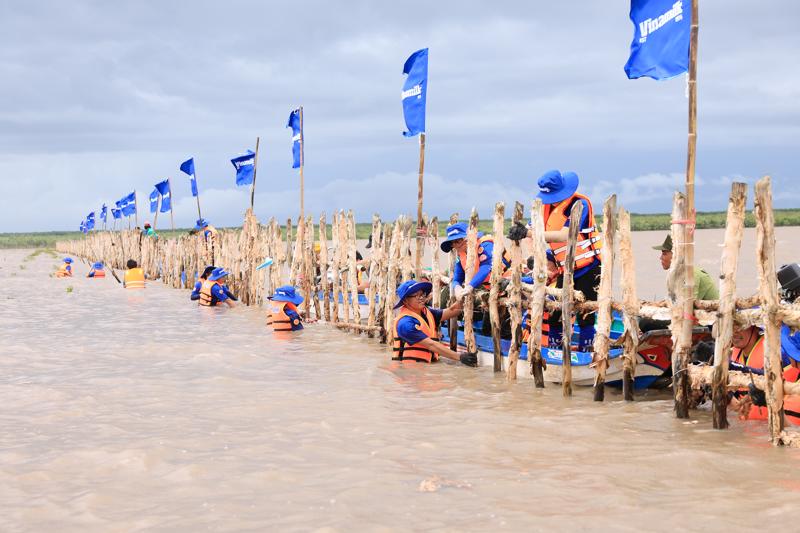 Vinamilk employees reinforce and repair the forest protection fence.
The 25-hectare Net Zero forest area supported by Vinamilk at Mũi Cà Mau National Park has now reached its second year of implementation. Numerous research, monitoring, and reporting activities have been carried out, including annual field trips where Vinamilk staff directly participate in forest regeneration efforts.
The Vinamilk Net Zero Forest in Đất Mũi
Traveling nearly an hour through the dense mangrove canopy by boat, members of the Vinamilk employee delegation were excited and enthusiastic during the second-year mangrove regeneration program at Mũi Cà Mau National Park. The group included nearly 60 members from Vinamilk offices, branches, and factories in Bắc Ninh, Ho Chi Minh City, and Cần Thơ.
Nguyễn Chí Cường – Director of Tiên Sơn Dairy Factory – shared that he traveled over 2,000 km from Bắc Ninh to Đất Mũi to join this meaningful activity.
“Although I’ve visited the southernmost point of Vietnam many times, this is the first time I’ve directly joined colleagues in such a meaningful effort—wading through mud and reinforcing seed-catching fences. Seeing the young mangroves thriving after a year moved me deeply,” he said.
The Vinamilk Net Zero Forest at Đất Mũi is a mangrove restoration project using natural regeneration and protection, implemented in collaboration with Gaia Nature Conservation Center and Mũi Cà Mau National Park since 2023.
Thanks to the protective fencing which helps retain mangrove propagules and limit human disturbance, within just one year, the forest has been covered by over 71,000 young mangrove trees, growing strongly in both height and density. Many trees have reached 40–50 cm, with an average density of 2,500–2,800 trees per hectare.
Most of the trees have developed visible root structures, helping retain sediment and increase carbon absorption. According to Ms. Huyền Đỗ – Founder & Director of Gaia Nature Conservation – mangroves store carbon not only in stems, leaves, and roots but also in soil sediments.
Thanks to this, mangroves can store 4–10 times more carbon than terrestrial forests, with storage periods lasting thousands of years.
“Although naturally regenerated forests grow slower than planted forests, they have higher biodiversity value and greater carbon absorption capacity. At the Vinamilk Net Zero Forest, regeneration is occurring surprisingly fast. We believe the project will soon achieve its original goals,” shared Mr. Lê Văn Dũng, Director of Mũi Cà Mau National Park.
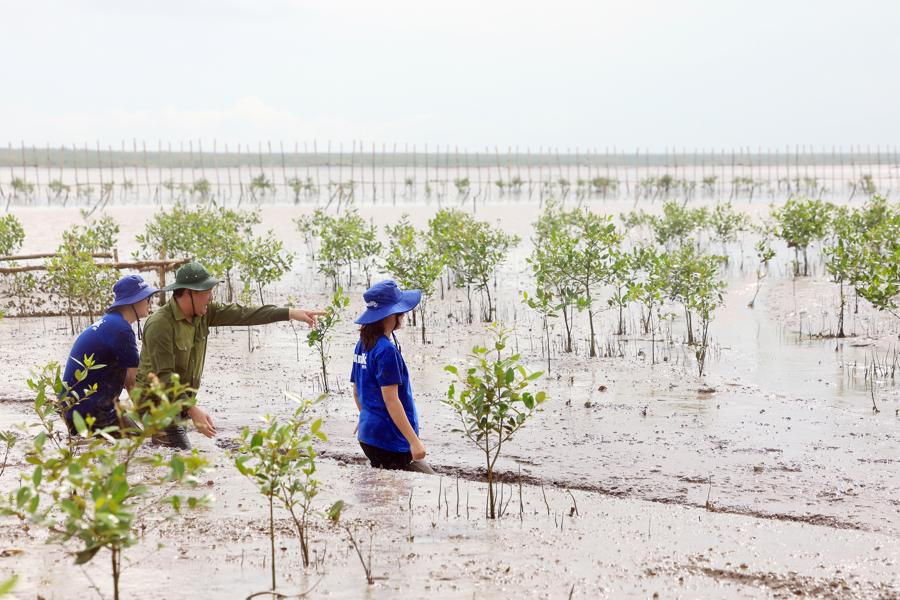 Tens of thousands of mangrove seedlings are rapidly covering the protected area
Joining hands to establish forest-based carbon sinks
Beyond its major potential for carbon sequestration, mangrove ecosystems in Cà Mau play a key role in climate resilience—especially in a province with three sides facing the sea and one of the longest coastlines in Vietnam. Cà Mau is among the Mekong Delta provinces most severely affected by climate change and loses 350–400 hectares of forest annually due to coastal erosion.
Since 2020, Cà Mau has mobilized additional resources from organizations and private enterprises to regenerate forests through several methods. However, at Mũi Cà Mau National Park, only 300 hectares have been restored over four years—barely the amount lost each year—highlighting the urgent need for stronger, more coordinated restoration efforts.
“We highly appreciate the organizations, individuals, and businesses contributing to mangrove protection and restoration. Enterprises, in particular, play a crucial role by providing essential resources. We hope more businesses will join and expand these meaningful efforts,” said Mr. Lê Văn Sử – Vice Chairman of Cà Mau People’s Committee.
Vinamilk’s mangrove regeneration initiative is part of its Net Zero Forest Project, aiming to regenerate 25 hectares of core mangrove forest, with 100,000–250,000 trees expected to grow over six years. Upon completion, the forest will become a carbon sink storing 17,000–20,000 tons of carbon, equivalent to 62,000–73,000 tons of CO₂e.
Lê Hoàng Minh – Chief Operations Officer and Director of Vinamilk’s Net Zero Project – shared:
“With the Vinamilk Net Zero Forest, we are not only protecting the environment or restoring ecosystems. We aim for measurable outcomes—specifically, carbon absorption capacity. This requires collaboration from enterprises, local authorities, technical units, and communities.”
Beyond the protective fence, Vinamilk collaborates with Gaia and the National Park on forest patrols, protection, awareness programs for local communities, and annual ecological monitoring to calculate the forest’s carbon absorption potential.
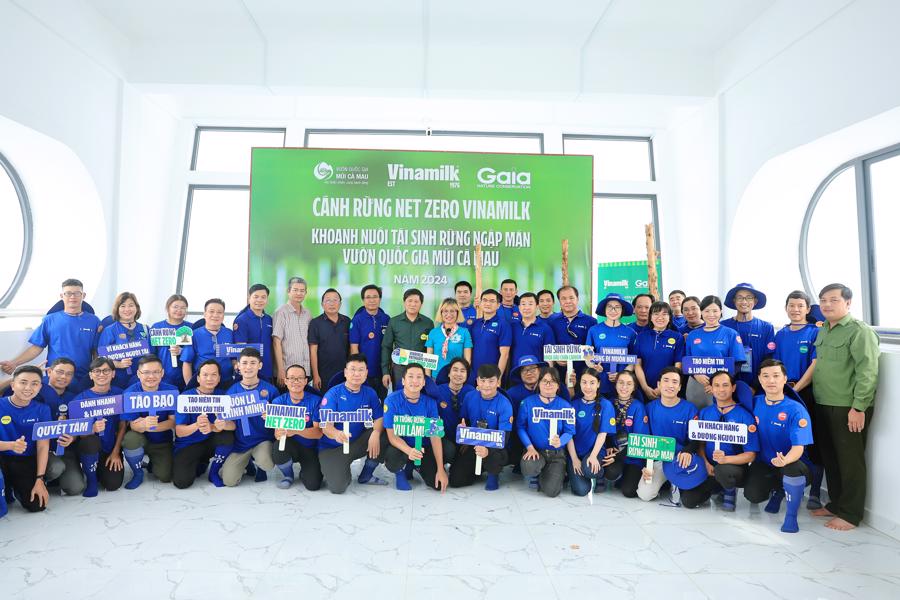 Businesses and local communities jointly restore forests, enhancing resource efficiency
Vinamilk is recognized as a leading example of corporate sustainability in Vietnam and was among the first companies to announce a roadmap towards Net Zero by 2050. The Net Zero Forest in Cà Mau is one of Vinamilk’s flagship contributions to establishing future carbon sinks.
Before this project, Vinamilk also implemented the “One Million Trees for Vietnam Fund”, planting over 1.1 million trees across 20 provinces, helping the company offset existing greenhouse gas emissions associated with production.